Healthy leadership is more than just a buzzword – it determines how effectively, mindfully and sustainably employees can act. In conversation with leadership coach Corinne Steiner, it becomes clear what role HR plays in this and how to recognise when stress becomes too much. Often, overload and exhaustion only become apparent in subtle ways – long before a manager really reaches their limits.
How can you tell when managers are reaching their limits?
Corinne: Limits rarely manifest themselves loudly. They express themselves in small changes, in language, in behaviour or in the way someone reacts. Many managers function perfectly on the outside until they lose their inner balance.
Managers are often caught between the expectations of the company, the needs of the team and their own standards. Especially in so-called sandwich positions, the area of conflict and thus the pressure of expectations is great.
HR managers can recognise the first signs if they listen and observe carefully: irritability, withdrawal, excessive control or conspicuous calm are typical indicators. Conflicts or unrest within the team are also often a reflection of a manager's overload.
‘What we observe in a manager always tells us something about the system in which they operate.’
Behaviour never arises in a vacuum: it is an expression of both individual stress and the structures, dynamics and expectations in the environment. Those who see both the person and the system recognise connections earlier and can provide more sustainable support.
What do you recommend then?
Corinne: When HR notices signs that a manager is under a lot of stress or that their behaviour is changing, the first step is to understand what is behind these signals and where they originate.
Stress can arise at various levels: in the person themselves, in their role or in the environment in which they work. It is helpful to look at these levels together. Sometimes the manager needs space for reflection or relief, sometimes the system needs adjustment and clarification. HR can build bridges here between personal perception and structural conditions.
One model that offers guidance here is Stephen Covey's Circle of Influence. It distinguishes between what people have direct influence over, what they have limited influence over, and what is beyond their control. Especially in complex organisations, this awareness helps to focus energy on what can be shaped and to let go of what is beyond one's sphere of influence. This clarity often has an immediate relieving effect.
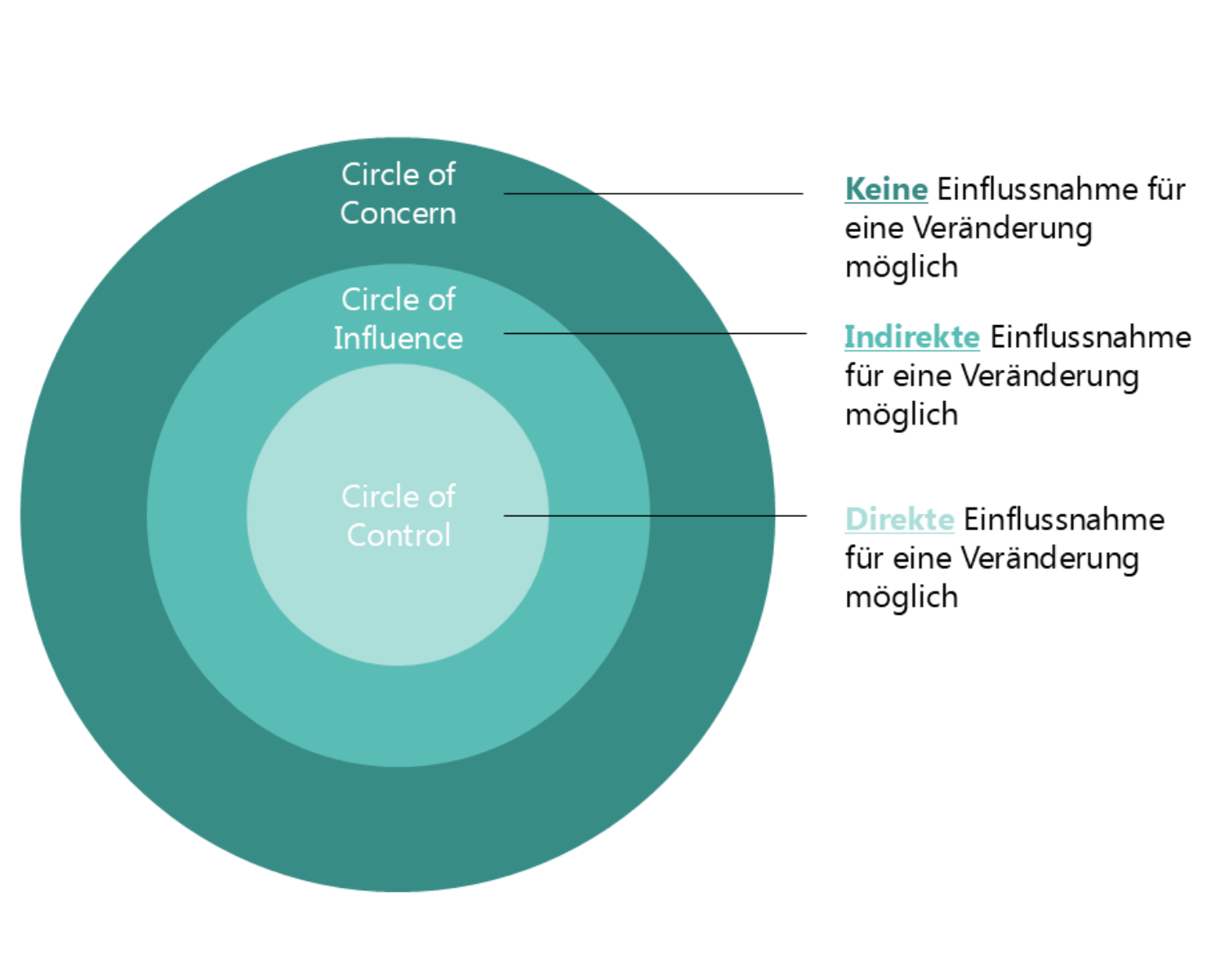
Stephen Covey’s Circle of Influence¹
The key is to seek a conversation with the manager.
It is important to conduct the conversation openly and respectfully. The question ‘Is everything alright?’ usually remains superficial, as it invites a quick ‘Yes, everything's fine. Everything's OK.’
It is better to use a concrete, observation-based approach, such as:
‘I've noticed that the situation in the team is very challenging at the moment. How can I support you in your role?’ This keeps the conversation on an equal footing and opens up space without exerting pressure.
Nevertheless, support always requires willingness. If a manager is not willing to take responsibility for themselves or accept help, HR can take action, but this is rarely effective. This is where the difference between well-intentioned care and professional clarification of responsibility becomes apparent: don't take over, but consciously give back.
‘I can see that the situation is very demanding for you. It is your responsibility to take good care of yourself and your team. We can support you, but we cannot act in your place.’
If the situation persists, HR can point out the consequences, for example on team dynamics, cooperation, health or the individual's role model function. This creates transparency about the consequences without assigning blame.
Pressure may well arise, but not as a means of power, but as a natural consequence of awareness and responsibility.
What does ‘healthy leadership’ mean to you?
And how can HR help to embed this attitude?
Corinne: Healthy leadership means consciously shaping responsibility for yourself, for others and for the system in which you operate. It thrives on clear communication, conscious handling of responsibility and boundaries, and mindful relationship building.
Healthy leadership creates a culture in which people feel secure, take responsibility and act effectively in an open, trusting collaboration, where performance comes from consistency, not pressure. People are at the forefront of the task, not behind it.
At its core, it is about awareness and responsibility, for oneself, for each other and for the system in which one operates. This attitude is particularly evident in those who bear responsibility:
‘A healthy leader knows their limits and knows what is good for them. They pay attention to signals, both in themselves and in others, and react before they become overwhelmed or exhausted. Because only those who lead themselves healthily can lead others healthily.’
For HR, this means anchoring healthy leadership as part of the corporate culture through awareness-raising, clear value orientation and framework conditions that allow and promote healthy leadership. In this way, HR managers create the basis on which managers can live out their responsibility consciously, effectively and humanely. Healthy leadership is not a method, but an attitude that is visible in everyday life, in decisions and in dealing with people. It thrives where personal responsibility, mindfulness and effectiveness are in balance.
How can HR support managers in leading in a healthy and effective way?
Corinne: For healthy leadership to be effective in everyday life, it needs space, reflection and exchange. HR can make a big difference here, not through control, but through support.
It is helpful if HR managers promote dialogue between managers, supervisors and teams through regular feedback meetings, reflection formats or collegial exchange rounds. This creates understanding, shared responsibility and new perspectives.
It is equally important to enable individual development processes.
Managers benefit from one-to-one coaching, peer programmes or self-management measures that help them recognise their own patterns and deal healthily with pressure, expectations and boundaries.
HR can also make resources visible and create structures that ease the burden, for example through clear responsibilities, realistic target systems or transparent communication during phases of change.
This creates an environment in which managers can take responsibility without losing themselves in it.
Healthy and effective leadership does not come about through more programmes, but through the conscious interplay of self-reflection, structural clarity and trusting dialogue – areas that HR actively shapes. Healthy leadership becomes a matter of course when it is part of the culture, not just an item on the agenda.
What role does HR play in establishing self-care as a strength within the company?
Corinne: Self-care is part of a healthy leadership culture. If companies want to secure their long-term performance, they should focus on the human side of work: energy, meaning, recovery and awareness.
1. HR has a key role to play here.
By removing the taboo surrounding the topic and understanding it as part of a professional leadership culture, HR creates space for open discussions about stress, limits and resources. This strengthens psychological security – the basis for trust, dialogue and healthy cooperation.
2. At the same time, HR has an important role model function:
By consciously managing its own resources and through structures that make breaks, focus times and flexible working arrangements a matter of course, HR shows that self-care is not an individual luxury and has nothing to do with weakness, but with responsibility.
In this way, self-care gradually becomes a cultural value, not as a feel-good measure, but as an expression of a professional attitude. It strengthens the resilience of the entire system, because those who are in touch with themselves lead more clearly, communicate more consciously and create a healthy working environment. And that is precisely what many managers find difficult in their everyday work.
How can HR take pressure off managers?
Corinne: Many managers believe they have everything under control – processes, goals, responsibilities. What they often overlook is that functioning is not the same as healthy self-care. Those who focus solely on efficiency and control easily lose touch with themselves.
The so-called soft factors – awareness, relationship building, relaxation and meaning – are in fact the basis of sustainable performance. If these are missing, sooner or later conflicts, exhaustion or a loss of focus and joy will arise – both professionally and privately.
Pressure rarely arises from work alone, but rather from ambiguity, conflicting expectations or a lack of priorities. Today's managers have complex roles: they lead people, make decisions and manage processes. It becomes challenging when expectations are unclear or contradictory.
This is where HR can help by clarifying priorities, making responsibilities visible and creating space for reflection. This allows managers to regain confidence and orientation.
Stephen Covey's Circle of Influence – mentioned above – offers a practical approach to this: it helps to focus energy on one's own sphere of influence instead of getting lost in worries and external responsibilities. This clarity noticeably reduces pressure and strengthens stability – for the manager, the team and the company.
Pressure cannot always be avoided, but it can be shared – this way, performance remains possible without compromising health.
Are there early warning signs for recognising exhaustion?
Corinne: Exhaustion creeps up on you.
If you look closely, you can recognise it early on in small, recurring changes: frequent overtime, withdrawal, perfectionism, sleep problems or increasing conflicts within the team are clear warning signs.
It is important not to judge these signs, but to understand them. Behind every symptom there is a need: for recognition, guidance or relief.
Helpful tools include models such as Freudenberger's 12 phases of burnout or a simple energy scale: on a scale of 1 (very exhausted) to 10 (full of energy) – how much energy do you have at the moment?
This reflection helps to recognise changes early on and to talk to people before stress becomes chronic.
Early warning signs are invitations to take a closer look. They should not lead to control or evaluation, but to conscious awareness and, where necessary, joint clarification and support. Recognising exhaustion early on not only protects people, but also the performance of the entire system.
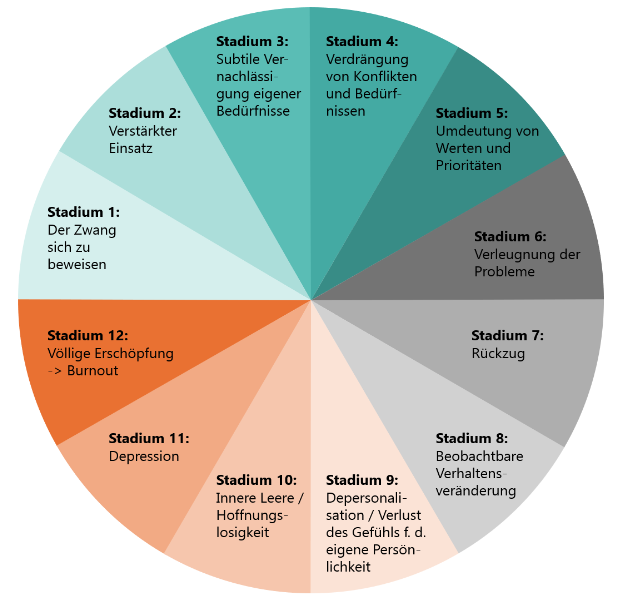
The 12 phases of burnout according to Freudenberger²
What three recommendations would you give HR to strengthen managers and teams in the long term?
Corinne: What HR can do in concrete terms goes far beyond processes and guidelines.
It's about consciously shaping culture, empowering people and creating structures in which leadership can have a healthy effect in the first place.
1. HR as a creator of trust and a culture of learning
Healthy collaboration arises where trust grows and exchange is possible.
HR can actively promote this culture by creating spaces for reflection and collegial support, for example in the form of intervision or peer formats in which managers share experiences, reflect on each other and learn from each other.
Equally important are containers for HR itself: places where it receives support so that it can effectively accompany managers in their role.
2. HR as an independent, people-oriented force in the system
In practice, HR is often embedded in structures that make this role difficult, often as a staff unit with limited decision-making authority or heavily dependent on management.
For HR to act effectively, it needs an independent position with a clear mandate and scope for action, not as an extension of management, but as a voice for the human aspect of the company.
HR brings balance to organisations by balancing interests, connecting perspectives and thus becoming a stabilising factor between performance and health.
3. Les RH en tant que coach réfléchie et co-créatrice systémique
Effective HR starts with itself.
Self-management, basic psychological skills and systemic thinking are key to recognising connections rather than just treating symptoms.
Coaching skills enable you to lead through questions rather than instructions, in line with the principle of ask, don't tell.
Targeted training in self-management, communication and systemic thinking strengthen this role in the long term.
En effet, le développement durable naît là où les RH ne se contentent pas de gérer des structures, mais contribuent à façonner la conscience et la culture de l'intérieur, selon une approche « inside-out ». Un renforcement durable se produit lorsque l'apprentissage, la réflexion et l'humanité ne sont pas des ajouts, mais font partie intégrante de la culture.
Sustainable development arises where HR not only manages structures, but also helps shape awareness and culture from the inside out. Sustainable strengthening occurs when learning, reflection and humanity are not add-ons, but part of the culture.
Healthy leadership thus arises where awareness, responsibility and humanity come together – and HR creates the space in which it can grow.
Thank you very much, Corinne, for the exciting and informative interview!
About Corinne Steiner:
Corinne Steiner stands for leadership that has an impact – from the inside out. She strengthens self-leadership and leadership awareness and supports managers in consciously shaping their role and leading effectively and authentically. In doing so, she enhances the quality of collaboration and awareness of a healthy, humane work culture.
Since 2019, she has been the owner of Corinne Steiner Coaching & Training, a coaching and training practice that strengthens leadership in all its facets – from self-leadership to employee and conversation management to lifestyle management.
[2] 12 phases of burnout according to Herbert Freudenberger and Gail North, 1992