Imagine you hear from someone you know that they love their new job. They tell you how straightforward the application process was, how quickly they received a response, and how welcome they felt.
Suddenly, that company is on your radar – even though you’d never heard of it before.
The exact same thing happens the other way round.
Anyone who goes through a cumbersome application process will talk about it.
Anyone who waits a week for confirmation of receipt will draw their own conclusions. Anyone who never hears back after an interview will look elsewhere. The candidate journey is the sum of all these moments. And at every touchpoint, it’s decided whether applicants stay – or go.
What is the candidate journey?
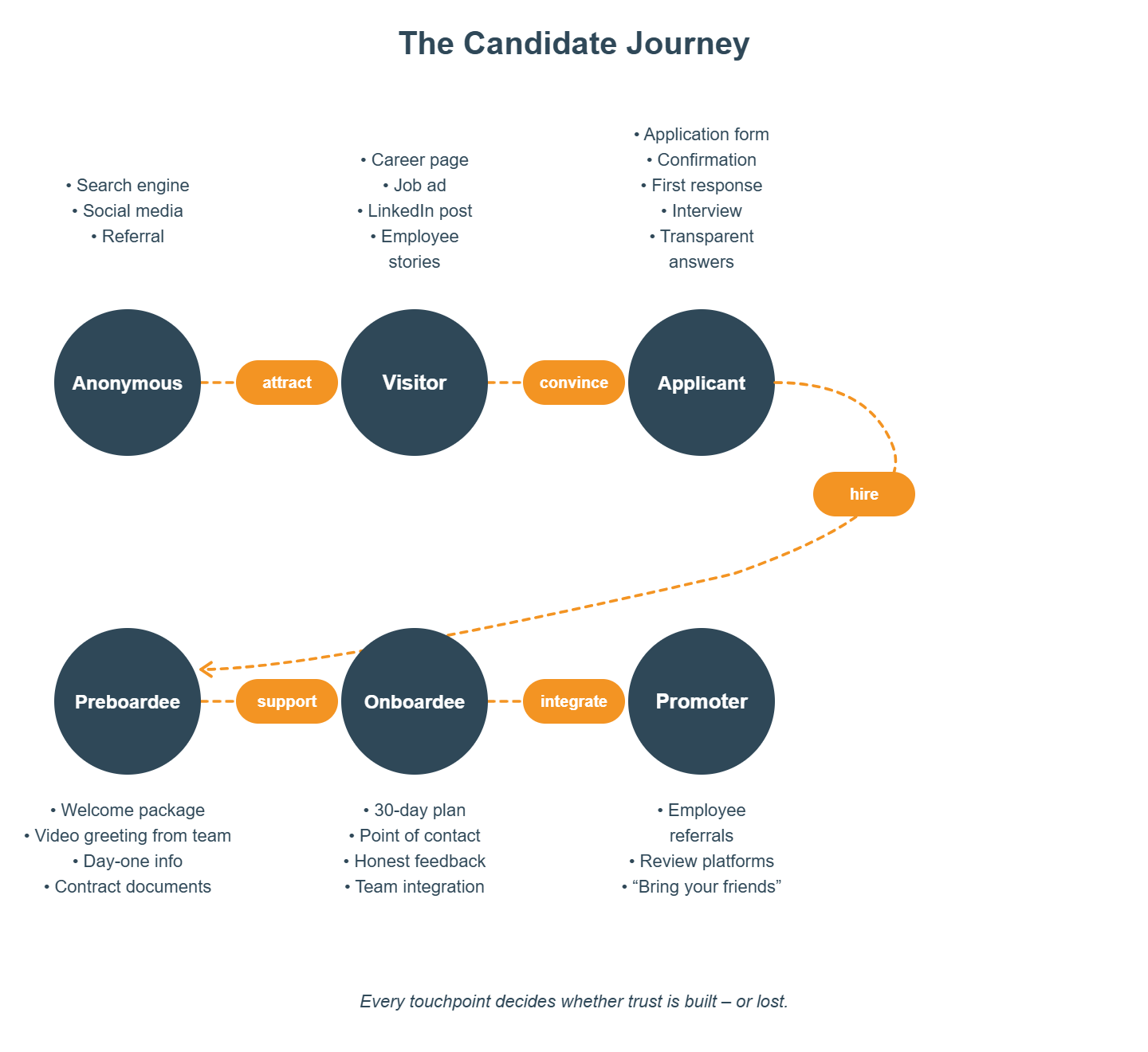
The candidate journey refers to all the phases and touchpoints someone goes through when applying to a company – from the first impression of a job advertisement or ad to signing the contract and the first few days on the job. Impressions are formed at each of these touchpoints: Am I welcome here? Does this process seem well thought out? Do I really want to work for this organisation?
According to the BEST RECRUITERS Study 2025/26 Switzerland, which analysed over 400 Swiss employers across the candidate journey, most companies still have a lot of catching up to do – regardless of size or sector.
Touchpoint 1: The job advertisement
The first contact with your company might be a traditional job advertisement, or perhaps a LinkedIn post that appears in the feed. Or a sponsored ad with a short video. Or someone hears about a position from a colleague. Sooner or later, most people end up at the advertisement anyway. The advertisement is the moment when interest turns into intent. Or perhaps not. Anyone who uses overly generic language here, lists requirements ad infinitum, or hides their own added value in a subordinate clause will lose the most interesting applicants at precisely this moment.
What works: honest insights into day-to-day life, concrete statements about the culture and the team – and content that works just as well on a smartphone as it does on a desktop.
Touchpoint 2: The careers page
In over 90 per cent of cases, applicants visit the careers page after seeing a job advert or a social media ad – before they apply. They don’t want to read the requirements again. They want to understand: Who are you really? How do you work together?
What applicants are looking for: real faces, concrete statements from people who work there, answers to the questions nobody asks out loud. Those who make this information openly available build trust before the first interview takes place.
Touchpoint 3: The application form
According to the Talention Recruiting Benchmark Report 2026, forms with more than eight mandatory fields have a three times higher abandonment rate. 50 per cent of all applications started are not completed – and the most common reason is a form that is too time-consuming.
Every unnecessary field is a hurdle. A good application form asks for the bare minimum – everything else can be clarified in the interview.
Touchpoint 4: Communication and feedback
61 per cent of applicants expect an initial response within a week. And yet, silence following an application is one of the most common experiences in the recruitment process.
Yet in the digital age, communication takes hardly any time. These moments define how applicants talk about your company – whether they got the position or not.
“Rejections are accepted. Radio silence is not.”
Touchpoint 5: The interview
According to the Career Barometer 2026, almost one in two young professionals abandons an application process because they lack a connection with the recruiter. Not because of the position. Because of the person. Equality is shown in small things: turning up prepared, asking genuine questions, answering transparently.
Touchpoint 6: Pre-boarding
The period between signing the contract and the first day at work is one of the most underestimated moments of the candidate journey. Those who remain silent during this phase risk a no-show on the first day. Those who get in touch – with a short message, a video greeting from the team, or simply clear information about what will happen on the first day – signal: You’ve made the right choice.
Some companies go one step further: a small welcome pack that arrives before the first day. A book, a local product, something that fits the company culture – or simply shows: We’ve been thinking of you even before you’ve started. Those working in the consumer sector have a natural advantage here – but the idea behind it works everywhere. It’s not about the value of the pack. It’s about the message.
Touchpoint 7: Onboarding
The first day at work is not an end point, but the start of a new stage of the journey. Those who are warmly welcomed automatically feel they belong more quickly and often stay longer. Those who feel lost in the first few weeks move on mentally, sometimes before the probationary period is over. Good onboarding isn’t just a welcome pack and laptop setup. It means: a person feels part of the team from the very start, understands how decisions are made, knows who to turn to – and realises that their choice was the right one. Specifically: a clear plan for the first 30 days, a contact person who is genuinely there for them, honest feedback in both directions, and a willingness to listen before offering correction.
Conclusion
The candidate journey is the sum of all the moments in which applicants decide whether they really want to join your organisation. These moments happen whether you shape them or not. The difference lies in whether they arise by chance or deliberately. A good recruitment process is not an end in itself. It is the most visible sign of how a company treats people – before they even become part of it. The right tool helps to structure touchpoints, automate communication and leave nothing to chance. But no tool can replace the attitude behind it: that applicants are not mere applicants, but people making a decision. Those who take both seriously (process and attitude) not only attract better applications, but also build trust.
What does your candidate journey really look like today? Thanks to the Refline e-recruiting solution, you can specifically improve various touchpoints with minimal effort.